
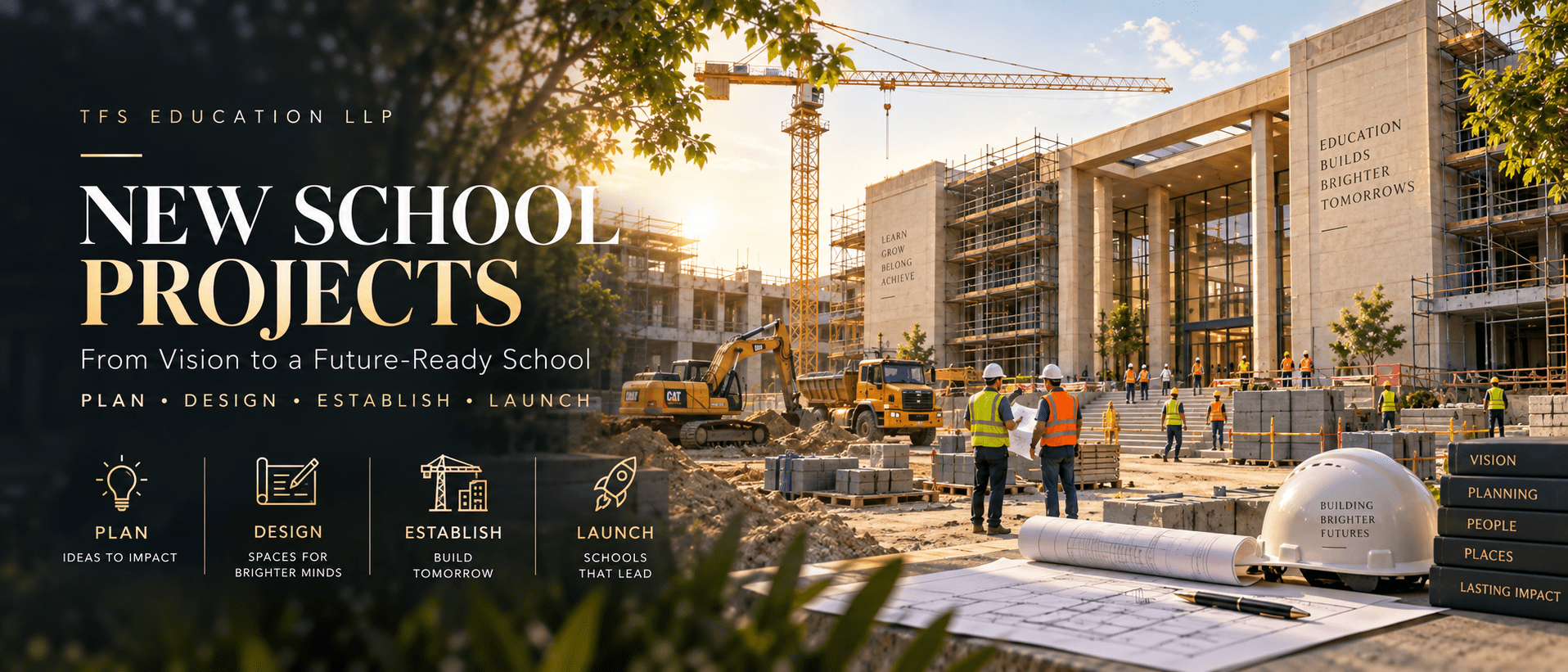
Introduction to New School Projects
Are you planning to establish a new school? If you want to know how to start a new school, stay with us to understand the important stages involved.
TFS Education undertakes consultancy for setting up new school projects, including schools planning for CBSE or CISCE affiliation. Wherever possible, promoters should involve professional consultants well before construction begins so that infrastructure, investment, statutory requirements and the future affiliation plan can be considered together.
Ideally, the planning process should begin approximately 6 to 12 months before the proposed start of school construction. Some of the important stages involved in establishing a new school are explained below.
Planning Stage
Starting a new school is a major project. It requires careful planning and proper execution at every level. Early planning can help avoid unnecessary changes, expenditure and difficulties at later stages.
1. School Model & Affiliating Board
The first step is to decide what type of school you intend to establish — a day school, day-boarding school or residential school. Infrastructure and investment requirements differ considerably depending upon the chosen model.
The proposed affiliating board should also be considered at the planning stage. Depending upon the vision and requirements of the promoters, the school may consider CBSE, CISCE or another appropriate board.
2. School Capacity / Intake Capacity
Promoters should determine the approximate future capacity of the school — for example, below 1,000 students, around 1,500 students, around 2,000 students or beyond.
Student capacity directly influences land utilisation, classrooms, laboratories, activity spaces, staffing, investment and other resources.
3. School Standards & Positioning
It is important to decide the proposed standard and positioning of the school. A study of the local population, competing schools, fee structures and the paying capacity of families in the catchment area can help promoters plan more realistically.
4. Investment Planning
Investment requirements depend upon the chosen school model, campus design, infrastructure, facilities and planned standards.
Depending upon the availability of funds, the school may be developed in a single phase or through planned stages. Even where development is phased, a clear long-term master plan is advisable.
5. Long-Term Financial Planning
Projecting the major income and expenditure requirements of the school for several years can help promoters understand capital requirements, operational costs and financial sustainability.
6. Survey / Feasibility Study
A survey of local conditions can help assess the need, scope and potential for a new school in the proposed location.
School Design & Infrastructure
7. School Design & Construction
School construction may take several months depending upon the scale, location and complexity of the project. In some cases, development may be undertaken in phases.
A well-planned architectural design should make efficient use of the available land while considering safety, accessibility, classrooms, laboratories, administration, sports and activity areas, circulation spaces, future expansion and applicable regulatory requirements.
Explore School Design & Construction Planning
8. Purchase & Procurement
Procurement may include furniture, interactive teaching systems, computers, laboratory equipment, kindergarten resources, library books, sports material, software, stationery and other school requirements.
Planning procurement well in advance helps control expenditure and ensures that important resources are available before the school opens.
9. Designing & Printing
The school may also need prospectus, admission forms, student planners, parent handbooks, registers, envelopes, stationery and other institutional material before commencement of admissions and operations.
People, Systems & Compliance
10. Staffing
Staff planning should consider the leadership team, teaching staff, administrative staff, salary structure, qualification requirements, recruitment timelines and training needs.
11. Licences, Permissions & Documentation
A school must obtain the permissions, recognition, certificates and statutory documentation applicable to its location, management structure and proposed affiliating board.
Depending upon applicability, these may include:
- Registration documents of the Society, Trust, Company or other eligible managing entity
- Land ownership, lease or sale documents
- Change of Land Use or other land-use permission, wherever applicable
- Recognition from the competent State Education authority
- Building Safety Certificate
- Fire Safety Certificate
- Safe Drinking Water Certificate
- Health & Sanitation Certificate
- Employee-related statutory registrations, wherever applicable
- Salary payment and banking arrangements
- Accounts and financial records
- State NOC, wherever applicable
- Documentation required by the proposed affiliating board
The exact documentation should always be checked according to the applicable State Government and affiliating board requirements at the relevant time.
12. Academic Systems & Procedures
Academic planning should include curriculum implementation, pedagogy, assessment practices, academic calendars, teacher processes, reporting systems and other procedures required for smooth functioning of the school.
Preparing for School Launch
13. Advertising, Marketing & Visibility
The school should develop an appropriate admission and communication strategy so that the local community understands the institution’s vision, facilities and educational offering.
14. SOP Implementation
Standard Operating Procedures can help establish consistency in academic, administrative and operational processes from the beginning.
15. Operational Guidance & Assistance
Operational planning before launch can help the leadership team coordinate people, systems, documentation, admissions and day-to-day readiness.
16. School Start-Up
Final preparation may include staff orientation, campus readiness, admissions processes, parent communication, academic planning and operational coordination for the opening session.
Conclusion
Commencing a new school can be challenging; however, with thoughtful planning and appropriate professional guidance, the vision of a well-structured educational institution can become a reality.
Planning a new school project? Talk to TFS Education about your vision and requirements.