

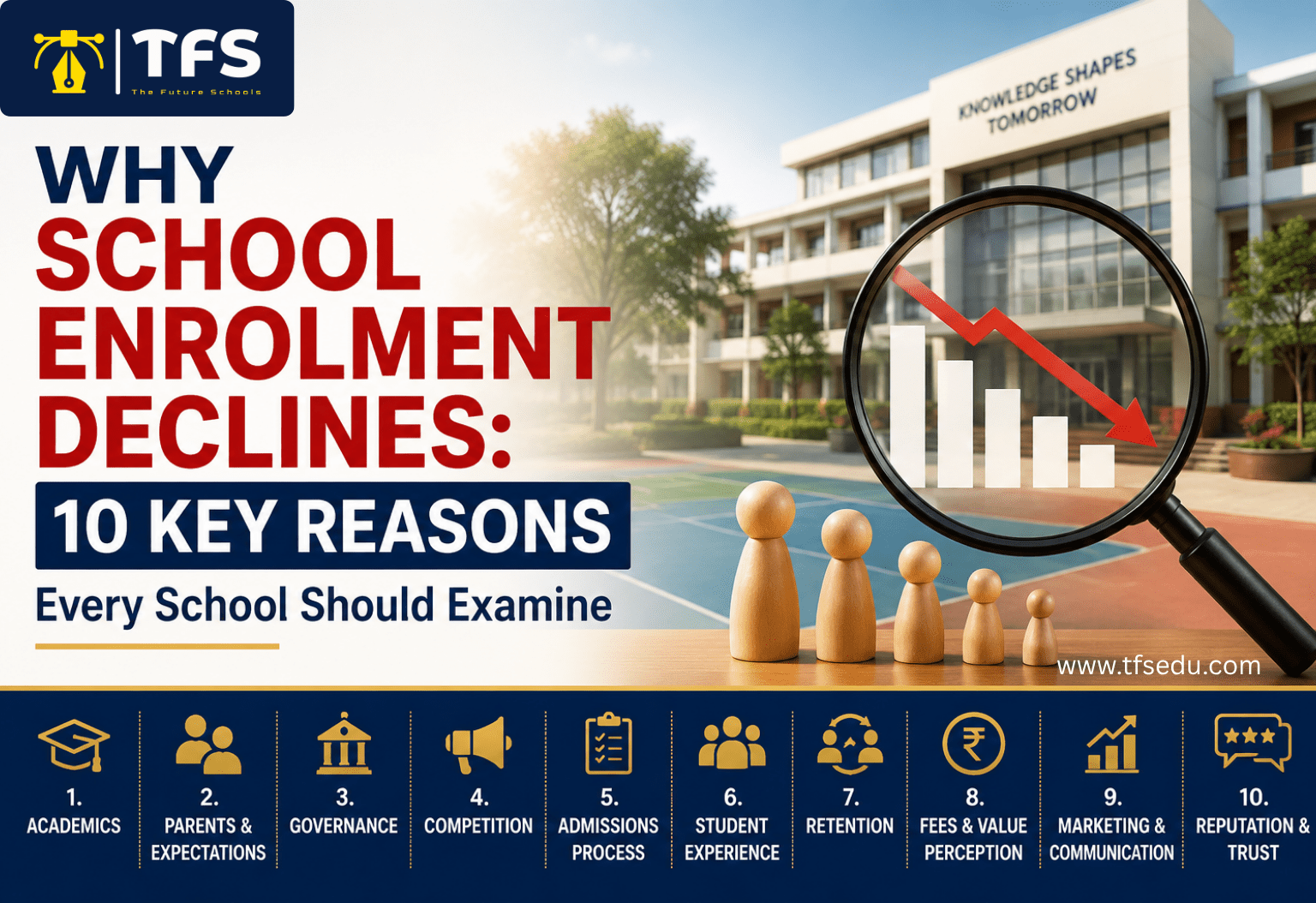

Why School Enrolment Declines Despite Good Infrastructure and Branding
School enrolment decline can be puzzling for school owners and management teams, particularly when a school has a good campus, modern classrooms, laboratories, sports facilities, experienced management and even a recognisable brand—yet student numbers continue to fall year after year.
The natural response is often to increase advertising, improve the website, renovate the campus, offer admission incentives or spend more on branding.
But these measures may not solve the problem.
Declining school enrolment is usually a symptom. The real challenge is identifying the underlying cause.
Parents may initially be attracted by infrastructure, branding and facilities, but their decision to continue with a school—and recommend it to others—is influenced by the complete educational experience.
In many cases, the reasons behind declining admissions are not immediately visible. A school may look impressive from outside while problems related to academics, leadership, parent satisfaction, teacher stability, governance or student retention are gradually affecting its reputation. Understanding the causes of school enrolment decline therefore requires looking beyond infrastructure and advertising.
You may like: Government schools face 86 Lakh enrollment decline in two years: UDISE
Here are 10 important reasons why student enrolment may decline even in apparently well-established schools.
1. Academic Quality and Teacher Stability Have Declined
Good infrastructure can attract parents to a school, but quality of education determines retention and reputation.
Frequent changes in teachers, weak classroom teaching, inadequate academic monitoring, poor foundational learning, ineffective assessment practices or disappointing academic results can gradually affect parent confidence.
Teacher stability is equally important.
Students need continuity, and parents expect competent and committed teachers. When teachers frequently leave, classes are repeatedly reassigned or experienced teachers are replaced without proper transition, parents begin questioning the academic environment.
Schools should therefore regularly monitor:
- Teacher retention
- Recruitment quality
- Classroom teaching standards
- Professional development
- Academic supervision
- Learning outcomes
- Teacher motivation
- Work culture
- Parent feedback regarding teaching
A school can continue to look impressive from outside while dissatisfaction with academics quietly grows within the parent community.
Over time, this affects both student retention and new admissions.
You may like: School Transformation
2. Existing Parents Are No Longer Recommending the School
One of the strongest sources of school admissions is not advertising—it is parent-to-parent recommendation.
Satisfied parents naturally talk about their child’s school among friends, relatives, colleagues and neighbourhood communities. Their recommendation carries a level of credibility that paid advertising cannot easily create.
The opposite is equally important.
When existing parents become dissatisfied, they may stop recommending the school. Some may even actively advise other parents against admission.
A school may therefore continue spending heavily on marketing while negative or indifferent word-of-mouth quietly reduces admission conversion.
School management should regularly ask a simple but important question:
Would our existing parents confidently recommend our school to another family?
If the answer is uncertain, management should find out why.
Parent referrals are often one of the clearest indicators of the real reputation of a school.
3. Good Infrastructure Is No Longer Enough
Modern classrooms, science laboratories, computer labs, sports facilities, attractive buildings and technology-enabled learning environments certainly matter. However, good infrastructure has increasingly become an expected feature rather than a unique advantage.
Parents today evaluate schools on several other factors, including:
- Teaching quality
- Student safety and discipline
- Individual attention
- Communication with parents
- Academic results
- Co-curricular opportunities
- Teacher stability
- School culture
- Leadership
- Student well-being
- Overall value for the fee charged
Infrastructure may influence the first impression, but infrastructure alone cannot create a successful school.
Parents eventually judge a school by what their child experiences every day.
4. The School Has Lost Its Differentiation
Many schools use similar expressions:
Holistic Education. Smart Classrooms. Future-Ready Learning. Overall Development. World-Class Infrastructure.
These may all be desirable, but if every school makes similar claims, they no longer provide meaningful differentiation.
A school must be able to answer a very simple question:
Why should a parent choose our school instead of the other good schools available nearby?
The answer should be clear, credible and visible in the actual functioning of the school—not merely in its prospectus, advertisements or social-media campaigns.
A school’s differentiation may come from academic excellence, personalised attention, strong values, innovative pedagogy, sports, technology, discipline, student opportunities, teacher quality or a distinctive school culture.
But there must be something meaningful that parents can recognise and experience. Schools that lose their distinctive identity can gradually lose market share even when their infrastructure remains strong.
5. Fees and Perceived Value Are No Longer Aligned
High fees do not necessarily cause declining enrolment. Parents are often willing to pay higher fees when they clearly see corresponding educational value. The problem arises when parents begin asking:
“What are we receiving here that justifies what we are paying?”
A competing school may have slightly less impressive infrastructure but stronger academics, better communication, more stable teachers, greater individual attention or a more responsive school environment.
Therefore, schools should evaluate not only their fee structure but also their perceived value proposition. The real question is not simply whether the school fee is high or low. The question is whether parents believe the educational experience justifies the fee being charged.
6. Parent Experience Has Deteriorated
Parents experience a school through much more than their child’s classroom. Reception, accounts, transport, teachers, coordinators, admission counsellors and school leadership collectively shape the parent’s perception of the institution. Unanswered calls, delayed responses, unresolved complaints, unfriendly interactions, inconsistent communication or an inaccessible management can gradually damage trust. Every interaction matters.
Parents may forgive occasional mistakes, but repeated poor experiences eventually change their perception of the school. A school may therefore have excellent facilities and reasonable academics but still lose parents because the overall parent experience is poor.
Strong schools do not merely communicate with parents. They listen to them, respond professionally and make them feel that legitimate concerns are taken seriously.
7. School Governance Has Become Too Centralised
In some institutions, centralised governance can become an overlooked contributor to school enrolment decline. This is one of the more sensitive—but important—reasons behind the decline of some established schools.
Management has an important responsibility to protect the school’s vision, philosophy, finances, policies and long-term direction. However, problems can arise when decision-making becomes excessively concentrated in one or two individuals and the institution gradually becomes personality-driven instead of vision-driven.
Personal preferences and beliefs may begin influencing academic and administrative decisions more than professional educational considerations or the original vision with which the institution was established.
One of the first consequences is often the weakening of the Principal’s role. The Principal should function as the academic and administrative leader of the school, within a clearly defined framework of accountability.
If the Principal is expected to seek approval for almost every meaningful decision or is largely reduced to implementing management instructions, professional authority gradually weakens.
Teachers quickly recognise where the real decision-making power lies. Some may begin bypassing the Principal. Coordinators become hesitant to take initiative. Senior teachers may stop contributing ideas. Eventually, employees learn that following instructions is safer than exercising professional judgement.
This can create a damaging sequence:
Excessive Management Control → Weak Principal Authority → Reduced Staff Ownership → Lower Motivation → Teacher Turnover → Inconsistent School Experience → Parent Dissatisfaction → Declining Reputation
Teachers and academic leaders should also have meaningful opportunities to contribute to decisions affecting teaching, students and school culture. Consultation does not weaken management authority. It usually improves the quality of decisions and creates greater ownership among those responsible for implementation.
A professionally governed school should therefore maintain an appropriate balance:
Management governs.
Principal leads.
Teachers contribute.
Systems ensure accountability.
Schools should remain vision-driven and system-driven rather than personality-driven.
Autonomy without accountability can certainly create problems—but accountability without reasonable professional autonomy can gradually destroy leadership.
8. The Admission Process Is Weak
Sometimes the problem is neither academics nor infrastructure. The school simply does not manage admissions professionally. Consider a hypothetical admission funnel:
1,000 Enquiries → 450 Campus Visits → 220 Applications → 160 Admissions
If the school tracks only the final 160 admissions, management has very little information about where potential students were lost.
Schools should monitor the complete admission journey:
Enquiry → Follow-up → Campus Visit → Application → Admission
They should know:
- How quickly enquiries are responded to
- How many enquiries result in campus visits
- How many visiting parents submit applications
- How many applications convert into admissions
- Why interested parents ultimately choose another school
Admission counsellors and front-office teams also need appropriate training because they often create the first real experience a prospective parent has with the school.
Without this information, increasing the advertising budget may simply generate more enquiries that continue to be poorly converted.
9. Competition Has Changed
School enrolment decline does not always mean that the school itself has deteriorated. Sometimes a school has not deteriorated significantly—but the market around it has improved.
New schools may enter with stronger academic systems, better facilities, competitive fees, improved transport networks, modern communication systems, specialised programmes or aggressive marketing.
Existing schools therefore need to periodically undertake a realistic competitor analysis.
The question should not only be:
“Are we better than we were five years ago?”
It should also be:
“Are we providing a stronger educational proposition than the alternatives available to parents today?”
A school cannot evaluate its performance only against its own past.
Parents compare schools with the options available to them now.
Even established schools must continue evolving.
10. The School Is Measuring Admissions but Ignoring Withdrawals
This is one of the most overlooked aspects of school growth.
Suppose a school admits 100 new students during an academic session but 60 existing students withdraw.
The school has not really grown by 100 students.
Its net increase is only 40 students.
New Admissions − Student Withdrawals = Net Enrolment Growth
Schools should therefore analyse withdrawals as carefully as new admissions.
Withdrawal data should be studied:
- Year-wise
- Class-wise
- Reason-wise
- Location-wise, where relevant
- Against previous years
If unusually high numbers of students leave after particular classes—such as KG, Class V, Class VIII or Class X—the pattern may reveal an underlying academic, structural, fee-related or competitive issue.
Management should also distinguish between unavoidable withdrawals, such as family relocation, and preventable withdrawals related to dissatisfaction with the school.
A school that continuously admits new students but loses large numbers of existing students may not have an admission problem at all.
It may have a retention problem.
Before Spending More on Marketing, Diagnose School Enrolment Decline
When management notices school enrolment decline, increasing the marketing budget is often the first response.
Schools may redesign brochures, increase digital advertising, organise admission events, offer discounts or invest further in infrastructure.
But marketing cannot permanently correct weaknesses in academics, governance, leadership, teacher quality, parent satisfaction or school culture.
Before investing further in advertising, management should seek answers to three fundamental questions:
Why are new parents not choosing our school?
What is making existing students leave?
Why are our existing parents not recommending us strongly enough?
The answers may sometimes be uncomfortable.
But they are far more valuable than another advertising campaign.
How to Diagnose School Enrolment Decline
A meaningful diagnosis of school enrolment decline should examine several interconnected areas:
| Area | What Should Be Examined |
| Admissions | Enquiries, campus visits, applications, conversions and lost admissions |
| Student Retention | Withdrawals, class-wise trends and reasons for leaving |
| Academics | Teaching quality, results, learning outcomes and academic monitoring |
| Teachers | Stability, motivation, professional development and work culture |
| Parents | Satisfaction, complaints, communication and referrals |
| Governance & Leadership | Management systems, Principal’s role, decision-making and accountability |
| Market & Competition | Competing schools, fees, positioning and changing expectations |
| School Experience | Discipline, activities, facilities, communication and institutional culture |
It is also valuable to obtain feedback from four different groups:
Current Parents | Parents Who Withdrew | Teachers | Parents Who Enquired but Chose Another School
The difference between what school management believes and what these stakeholders actually experience often reveals the real reason behind declining enrolment.
Conclusion: Infrastructure Attracts Attention, Experience Builds Reputation
Addressing school enrolment decline therefore begins with identifying what has actually changed. There is no single formula for increasing school enrolment.
Every school operates in a different social, economic and competitive environment.
However, one principle remains consistent:
Good infrastructure may attract parents to visit a school. Good education and a positive school experience make them stay—and recommend it to others.
When a school with good infrastructure and branding experiences continuous enrolment decline, management should resist the temptation to treat it purely as a marketing problem.
The first priority should be diagnosis.
Identify what has changed.
Understand what parents are experiencing.
Study why students are leaving.
Examine competitors objectively.
Evaluate academic quality and teacher stability.
Review leadership and governance systems.
Assess whether the school continues to operate according to its institutional vision.
Then develop a targeted improvement strategy based on evidence rather than assumptions.
Because sustainable school growth does not come merely from attracting more admissions.
It comes from building a school that parents trust, students value, teachers are proud to serve and communities confidently recommend.
Is Your School Experiencing Stagnant or Declining Enrolment?
TFS Education LLP works with schools in areas of institutional development, school transformation, academic improvement, infrastructure planning, management systems and CBSE/CISCE affiliation.
A structured school review can help management identify the factors affecting admissions, student retention, parent satisfaction, academic quality, leadership and long-term institutional growth, and develop practical priorities for improvement.
TFS Education LLP
Building Future-Ready Schools